

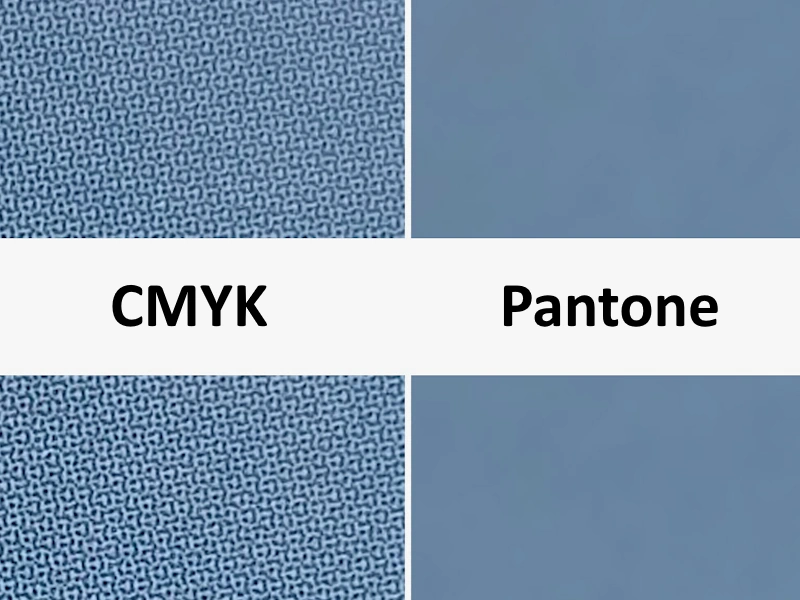
These are two popular color systems used in printing. Both assist in packaging and design color. They have various ways of working and do not yield the same results.
The right system is chosen in terms of quality and consistency. Businesses often compare Pantone color vs. CMYK to decide what suits their needs.
What is the Pantone Color System?
It is a global color-matching system. It employs pre-prepared colors to form precise colors. Every color has a special code that easily identifies shades of the same print with the help of different color codes.
This system is quite useful with brand colors that stay the same every time. Pantone guides are used by designers and printers in selecting colors.
It is commonly applied to logos and high-grade packaging where the color accuracy is extremely important.
What is CMYK Printing?
This is a combination of five colors.
- Cyan
- Magenta
- Yellow
- Black
Numerous colors are produced with these four inks in various combinations. This can be applied to the majority of digital and offset printing. It is effective with magazines and the packaging of products.
Key Differences
Both are different from each other, and some of them are here.
- Pantone uses pre-mixed inks, while CMYK mixes four inks to create colors
- The first one provides exact color matching, while the other may show slight variations
- Pantone is best for solid colors, and the other is ideal for images and gradients
- CMYK is budget-friendly, and Pantone printing can be more expensive
- It is easy to use Pantone for branding and for general printing. CMYK is the best option
- Pantone has limited colors per print, and CMYK can produce many shades
Both systems are useful in different ways. The right choice depends on design needs and printing goals.
Color Accuracy and Consistency
Pantone also has very high color accuracy because inks are pre-mixed. This will guarantee a repeat of the same color. It is ideal with logos and brand colors.
CMYK combines inks when printing. This may cause slight variation in color between different prints.
Results can also be influenced by lighting and the type of paper. Pantone can be better used in projects where precise color is essential.
Cost Comparison
It tends to be more costly by virtue of the use of special inks. Because every color is to be done on a separate plate, it is more expensive.
Small designs that use a small number of colors are frequently drawn with it. CMYK printing is less expensive. It is made with four standard inks, producing numerous colors. This saves setup and print expenses.
CMYK is preferable when there are numerous colors on a large project. Budget is also a major factor in deciding on either of these systems.
Best Use for Pantone
This is ideal for designs that require a different color to match. It is popular in logos and brand image.
When a business wants the same colors on all materials, they make use of Pantone. It is also best suited to high-end packaging and special inks.
Pantone is a good choice with minimal colors. It is commonly applied in company branding and high-end products.
This system will maintain the same colors at all times, something that is essential in brand recognition.
Explore Usage of CMYK
Designs that contain numerous colors and images are best. It is usually applied to brochures, magazines, and posters. Photos and gradients are compatible with this system.
It can fit large print runs also. CMYK will suit normal printing. Companies are using it due to its affordability. It enables designers to design in colors and details.
Advantages of Pantone Printing
It offers many benefits, especially for color accuracy and branding.
- Provides exact and consistent color results
- Uses pre-mixed inks for better quality
- Ideal for brand logos and identity
- Works well for solid colors
- Gives a premium and professional look
- Ensures uniform color across different materials
Pantone is a strong choice for projects where color precision is very important.
Reasons for CMYK Printing
It is widely used because it is flexible and affordable.
- Uses four inks to create many colors
- Suitable for full-color images and designs
- More affordable than Pantone printing
- Ideal for large print runs
- Works well with digital and offset printing
- Allows detailed and colorful graphics
CMYK is a practical option for most printing needs and large projects.
Restrictions of Pantone
There are some limitations to using these colors. It may be costlier than alternative means.
- The colors are separated by ink, which is more expensive.
- It does not suit intricate images with numerous colors.
- Printing time is longer.
- Pantone does not allow a gradient or shaded design.
- It is primarily applied to simple designs.
- not be the most cost-effective option.
Limitations of CMYK
This also has some drawbacks.
- Matches of color are not always precise.
- Due to paper and lighting conditions, results may vary.
- Special and bright colors are more difficult to attain.
- Certain tints will appear pale in comparison to Pantone.
- Consistency can be an issue in repeated prints.
It is not suitable where strict brand colors are required.
How to Select The Right Option For Packaging?
It needs to focus on your objectives when selecting colors.
- Pantone for exact color matching
- Select CMYK for full-color images
- Use Pantone for branding and logos
- Pick CMYK for budget-friendly printing
- Consider Pantone for premium packaging
- Use CMYK for large print quantities
The right choice depends on design goals and required quality.
Conclusion
Branding requires consistent and accurate colors. Pantone is a better choice for a strong brand identity. It ensures the same color across all materials.
This helps customers recognize the brand easily. CMYK is useful for marketing materials like brochures and ads.
However, it may not match the exact brand colors every time. Many businesses use both systems together.
Pantone is used for logos, and CMYK is used for detailed designs and images.

