

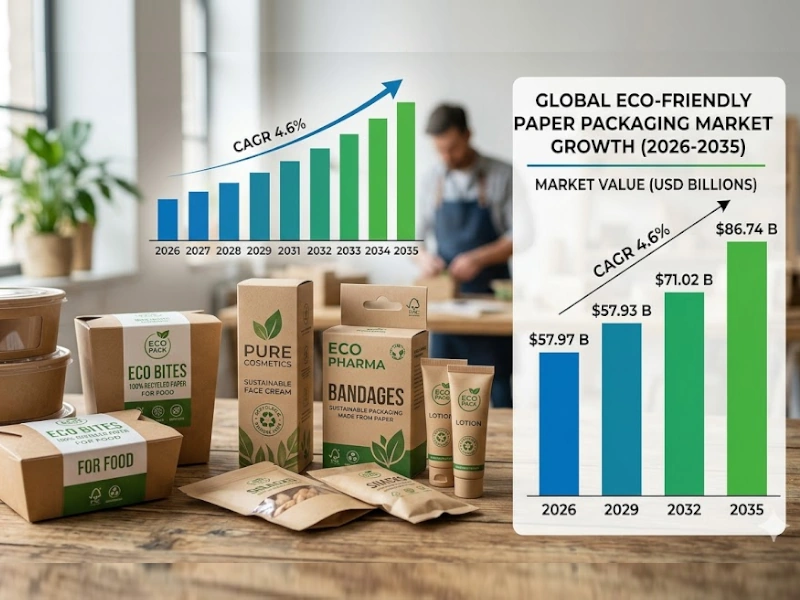
The global flexible paper market is witnessing stable growth due to the changing needs of the economy regarding environmentally friendly packaging solutions.
According to predictions, the industry is expected to develop from $57.97 billion in 2026 to $86.74 billion in 2035 with a CAGR of 4.58%.
The growing tendency to adopt green solutions in different fields, including food, healthcare, and cosmetics, contributes to the expansion of the industry.
There exist several types of flexible papers, such as pouches, whose market share equals 36.71%, as well as roll stock, wraps, and shrink sleeves.
Among applications, the largest share belongs to food and beverage products, amounting to 44.23%.
Market Overview and Structure
The flexible paper packaging market includes detailed insights into regional performance and production trends.
North America leads with a 36.25% share, while Asia Pacific is the fastest-growing region with a CAGR of 6.78%.
Europe, Latin America, and the Middle East & Africa also contribute significantly to overall demand.
This market study highlights production volumes, pricing patterns, trade flows, and value chain developments.
It also provides competitive analysis and detailed profiles of key manufacturers and suppliers operating globally.
What Makes Flexible Paper Packaging Unique?
Flexible paper packaging performs the same protective function as plastic packaging but is made from renewable, fossil-free materials.
It is lightweight, typically below 100 grams per square meter, and free from silicone, glassine, and heavy laminations.
It is widely used for products such as:
- Chocolates and confectionery
- Pet food
- Ready meals
- Personal hygiene products
Fibrous materials allow manufacturers to create various formats like bags, pouches, and wraps. This versatility makes paper a strong alternative to plastic packaging.
Growing Preference for Paper-Based Solutions
Today, many brands prefer paper packaging over plastic due to its strength, thin structure, and sustainability. Paper is safe for food contact and supports both digital and traditional printing.
As a result, demand is increasing steadily. The shift is further supported by environmental awareness, strict regulations, and global sustainability goals.
Companies are investing more in innovative paper solutions to meet these expectations.
Key Growth Drivers
Several factors are driving market expansion:
- Rising demand for eco-friendly packaging
- Government regulations limiting plastic use
- Cost efficiency and improved shelf life
- Increased investments in sustainable materials
Growth in e-commerce packaging
The global packaging industry itself is growing rapidly, expected to reach USD 1.58 trillion by 2032. This growth directly supports the adoption of paper-based flexible packaging.
Future Demand Trends
The market is set to evolve further due to changing consumer preferences and industry needs:
- Increasing demand for plastic-free packaging formats
- Growth in e-commerce is boosting the use of lightweight packaging
- Expansion of the food and snack industries
- Government bans on single-use plastics
- Rising need for premium printing and branding
- Development of advanced coating technologies
- Adoption of personal and home care products
- Growth of quick-service restaurants (QSRs)
- Focus on circular economy initiatives
These trends will continue to shape the barrier coated flexible paper packaging market, especially with the introduction of water-based and bio-based coatings.
Production and Global Supply
Flexible paper packaging is produced at a large scale in several countries. China leads with 14.6 million metric tons, followed by the United States, Germany, India, and Japan.
These countries play a major role in meeting global demand and supporting supply chains across industries.
Key Trends and Insights
Pouches dominate packaging formats due to their lightweight and cost-saving benefits
- Food and beverage applications lead market demand
- Asia Pacific is the fastest-growing region
- New coating technologies improve moisture resistance and durability
- Digital printing enables better customization and branding
Flexible paper packaging is becoming popular because it supports convenience, sustainability, and modern design needs.
Role of Technology and Innovation
Technology is playing a vital role in market development. Artificial Intelligence (AI) is helping manufacturers improve operations and understand consumer trends.
AI applications include:
- Predictive analysis for demand forecasting
- Automation to reduce labor costs
- Supply chain optimization
- Smart packaging design with QR codes
These advancements are improving efficiency, reducing errors, and enhancing product quality.
Market Challenges
Despite strong growth, the industry faces some challenges:
- Limited recycling infrastructure in some regions
- Reduced strength after multiple recycling cycles
- Need for barrier coatings that complicate recycling
- Concerns about deforestation and biodiversity loss
Reports indicate that paper production contributes significantly to global carbon emissions. These issues may slow market growth if not addressed properly.
Opportunities in Sustainability
The shift toward sustainability presents major opportunities. Governments and companies are promoting eco-friendly packaging solutions.
Leading brands are investing in paper-based innovations such as:
- Paper bottles
- Recyclable food wrappers
- High-performance paper pouches
These developments show how companies are moving away from plastic and adopting renewable materials.
Regional Insights
North America leads due to strict environmental regulations and high recycling rates
Asia Pacific is growing rapidly because of urbanization and rising incomes
Europe supports sustainable packaging through strong policies
Countries like China and India are seeing increased demand due to expanding industries and e-commerce growth.
Market Outlook
The future of the market looks very promising, with growth expected uniformly across the regions.
The use of flexible packaging will continue gaining popularity with its lightness, economical pricing, and sustainability.
Sustainability, innovation, and convenience will continue to dominate growth trends with increased focus on eco-friendliness from various corporations, leading to an increased demand for paper-based flexible packaging.
Conclusion
There have been some remarkable changes within the packaging industry, and the shift towards paper-based packaging has been a central part of these changes.
Given the advancements and rising awareness about the flexible paper market, future growth looks bright for paper-based flexible packaging.

