

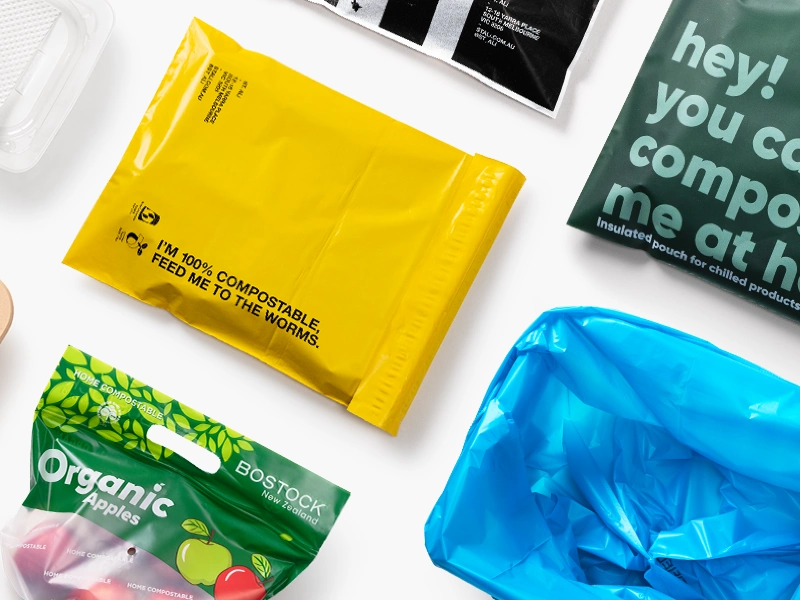
EcoEnclose Editorial Team reveals the truth about compostable packaging through this press release.
It has become a popular topic of compostable packaging news today. This natural packaging is usually put forth as the final solution to plastic pollution.
It carries a positive image. It is natural and environmentally friendly, but not unusual to find many brands with labels of compostable on their products. Consumers feel that they are making the correct decision when they see these labels.
Sustainability professionals believe there is more to it. Compostable packaging would be a beneficial option in some circumstances.
It is not necessarily the most sustainable one. The environmental effects of its production, use, and disposal are determined.
Compostable packaging does not necessarily provide people with the benefits without the proper systems in place.
The materials that are compostable are meant to decompose into natural components such as water and organic elements.
There are conditions that are normally required during this process. The majority of compostable packaging requires composting plants.
The facilities regulate the amount of heat and oxygen to aid in the degradation of materials.
The problem is access. Numerous communities lack industrial composting centers. In the places where there are no adequate facilities, the compostable packaging usually gets into standard trash bins.
It is deposited in landfills there. Landfills lack the appropriate environment for composting. The materials may require a long time to decompose.
They can also emit methane gas in a process of decomposition in certain instances. Methane is a strong greenhouse gas that promotes climate change.
Contamination in the recycling systems is another issue. Plastic can appear to be very similar to compostable packaging.
The consumers might have a difficult time. This will decrease the standard of recycled products and raise the process cost.
Clear labeling helps, but confusion remains common. Some products are labeled as biodegradable, and others are labeled as compostable. These terms are not always understood by the public.
Biodegradable materials may break down over time, but not necessarily in a controlled or safe way.
Compostable materials require specific conditions. Without education and awareness, good intentions may not lead to positive outcomes.
Another factor of importance is cost. The cost of compostable packaging may be higher to manufacture compared to conventional plastic or even recyclable packaging.
In the case of big companies, this extra expense can be borne. In the case of a small business, it may cause a financial burden.
In case the cost of packaging is high, and the resultant cost of the product increases, it may be experienced by the consumers.
The initiatives of sustainability should be a compromise between the ecological objectives and the economic realities.
Another problem is that of raw materials. There are numerous compostable items that are produced out of crops like corn, sugarcane, or other vegetables.
It is a good thing that these materials are renewable. Nevertheless, agricultural activities need land, water, fertilizer, and energy.
Mass production can either be a threat to food production or cause a change to land use. Unless farming is sustainable, the environmental footprint may grow.
There is also transportation, which contributes to the total impact. Compostable materials might have to be transported over a long distance to be processed or manufactured.
When reducing true sustainability, the emissions of transportation have to be taken into account.
Any product that is labeled compostable is not necessarily low-impact. The full life cycle matters.
Experts encourage companies to think beyond simple labels. Sustainability should be measured across the entire supply chain.
This includes sourcing, manufacturing, transportation, usage, and disposal. In some cases, recyclable packaging may be a better option. High-quality recyclable materials can be processed and reused multiple times.
Another alternative is the reusable packaging system. Reusable containers have the potential to greatly reduce waste, especially when made correctly.
Customers refill or send back packaging that they have used once. Planning and infrastructure are needed in this model, though this model may give long-term environmental returns.
That said, compostable packaging still has value. It can be highly effective in specific situations.
For example, food waste collection programs benefit from compostable liners and containers.
When food scraps and packaging can be composted together, contamination is reduced. In cities with strong composting systems, compostable packaging can work well.
Policy and infrastructure play a major role. Governments that promote composting facilities and provide clear guidelines can improve outcomes.
Investment in waste management systems is essential. Without proper support, even the best materials may fail to achieve sustainability goals.
Consumer behavior also matters. Even the most eco-friendly packaging requires correct disposal.
Education campaigns can help people understand where and how to compost materials. Clear instructions on packaging can guide users. Transparency builds trust and improves results.
Businesses should avoid oversimplifying sustainability claims. Green marketing can attract customers, but it must be honest.
Overstating the benefits of compostable packaging can lead to accusations of greenwashing. Companies that communicate openly about both advantages and limitations earn greater credibility.
“Sustainability is not about choosing one label over another,” said a sustainability advisor.
“It is about understanding systems. Compostable packaging can be part of the solution. But it must be supported by infrastructure and responsible design.”
Innovation continues in the packaging industry. Researchers are developing new materials that break down more efficiently.
Some companies are exploring hybrid solutions that combine composability with recyclability.
Others focus on reducing overall packaging use. The most sustainable package is often the one that uses fewer resources in the first place.
Businesses are encouraged to conduct full life cycle assessments before making changes. These assessments evaluate environmental impact from start to finish.
Data-driven decisions help avoid unintended consequences. What works in one region may not work in another.
The truth is clear. A compostable packaging has its advantages and disadvantages. It is able to minimize waste in the case of the correct systems.
It may also pose some difficulties in case of the inadequacy of the infrastructure. Sustainability involves proper planning and continuous upgrading. Moderate decisions lead to real progress.
Taking the big picture, companies and policymakers will be able to develop solutions that can really help in saving the planet.

