

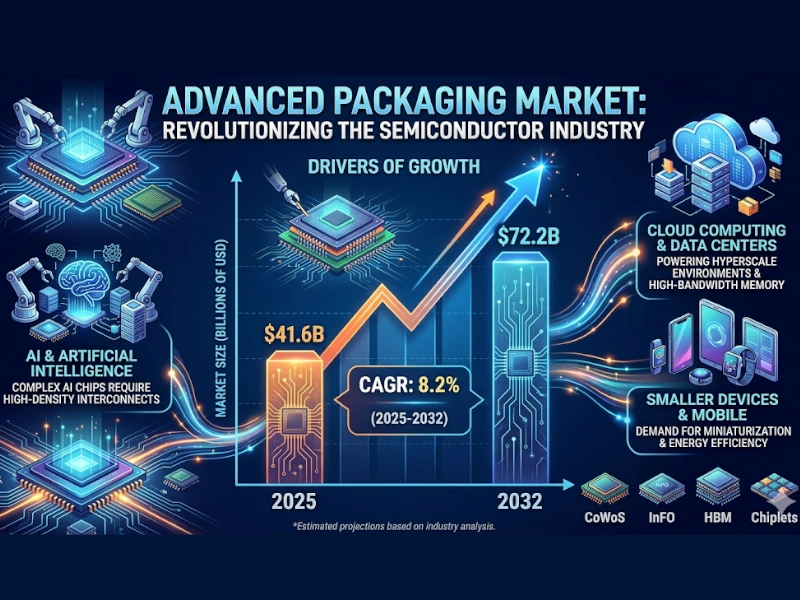
There is a high growth and innovation in the advanced semiconductor packaging market.
The market will grow to USD 41.61 billion in 2025 and to USD 72.24 billion in 2032 with a compound annual growth rate of 8.2.
This is fueled by the increasing need for cloud computing, artificial intelligence (AI), and miniaturized electronic devices in different industries.
Key Market Drivers
The market has a high concentration of major players. These companies are investing in innovative packaging technologies to meet growing demands.
Demand for Smaller
There is a high concentration of large players in the market. These firms are investing in new packaging technologies to satisfy the increasing needs.
- The global consumer is insisting on thinner, more powerful electronic products like smartphones and wearable technology. In order to fulfill this need:
- Advanced semiconductor packaging combines additional chips and passive devices into a smaller area.
- Fan-out and flip-chip packaging technologies permit ultra-thin form factors.
- It becomes possible to make smaller and more efficient devices without taking away performance.
These inventions also make electronics viable and small enough to meet contemporary consumer demands for technology.
Growth of IoT and 5G Networks
The IoT and 5G networks are advancing rapidly.
- The compact system-in-package solutions are needed in connected devices in homes and industries.
- Packaging solutions are expected to ensure that sensitive parts are not affected by moisture or vibration.
- Robotic applications such as autonomous vehicles and industrial robotics produce heat, which poses the need to implement the latest cooling and thermal management methods.
- High 5G network bandwidth facilitates huge data creation, which creates pressure to adopt multi- die integration technologies. These necessitate advanced semiconductor packaging to be viable in high-performance and reliable machines.
These factors make advanced semiconductor packaging essential for efficient and reliable devices.
Market Challenges
Advanced packaging enhances performance and miniaturization, but the prices are prohibitive.
- The process of updating the production lines and equipment is a capital-intensive exercise.
- Training of the workforce and obtaining specialized materials are also cost-additive.
- New technologies and rising costs may have less initial yield.
These smaller producers or companies in markets with price sensitivity may wait until the benefits outweigh the costs.
Market Opportunities
There is an increase in electronics in vehicles because
- Advanced driver-assistance systems
- Connectivity and infotainment features.
- Electric and autonomous car technologies.
- Advanced semiconductor packaging made possible
- High functional integration
- Lower power consumption
- Reliable multi-chip interconnections
This expansion will present new business prospects to semiconductor firms in terms of partnering with automakers and suppliers.
Strategies by Leading Companies
All the companies prefer using some tactics.
3D or 2.5D IC Packaging
Leading companies focus on 3D and 2.5D packaging for computing, mobile, and connectivity applications. Example: Intel’s Embedded Multi-die Interconnect Bridge.
- Companies partner with top foundries to access advanced process nodes and co-develop new packaging technologies. For example, Amkor collaborates with Samsung and GlobalFoundries.
- Firms target AI and autonomous vehicles. They offer custom packaging solutions for early market advantage.
Segmental Analysis
Segmental analysis breaks a market into smaller parts to better understand trends and growth opportunities in each segment.
Flip Chip Packaging
Expected to hold 39.8% market share in 2025.
- High input or output connection density
- Short interconnects for better signal performance
- Copper pillar bumping for enhanced electrical and thermal properties
Fan Out Wafer Level Packaging
Enables ultra-thin devices and improved thermal performance.
- Supports stacking of logic and memory chips for high-performance computing.
- Integrates multiple components in a single package for compact designs.
Advanced packaging ensures processors can handle emerging AI and autonomous vehicle applications efficiently.
By End-User Industry
- Devices like smartphones and wearables need aggressive miniaturization.
- Increasing electronics content in vehicles drives demand for advanced packaging.
- Supports features like ADAS, infotainment, and electric vehicle powertrains.
- The 42” x 42” pallet size is widely used in telecom, paint, and coating industries.
Healthcare and defense increasingly adopt miniaturized electronics requiring specialized packaging solutions.
Competitive Landscape
Key companies operating in the advanced semiconductor packaging market include Advanced
- Micro Devices, Inc.
- Intel Corporation
- Hitachi, Ltd.
- ASE Technology Holding Co., Ltd.
- Amkor Technology
- STMicroelectronics
- Infineon Technologies
- Samsung Electronics Co., Ltd.
These companies focus on innovation and emerging applications to strengthen their market position.
Recent Developments
Samsung Electronics (July 2024)
Established a team for high-bandwidth memory research that is critical for AI devices.
Resonac Corporation (July 2024)
Launched “US-JOINT” initiative with five U.S.-based companies for advanced packaging R&D, focusing on 2.5D and 3D technologies for AI and autonomous driving.
Market Summary
The high-technology semiconductor packaging market is booming because of
- Miniaturization of consumer electronics.
- The emergence of AI, IoT, and 5G applications.
Such major packaging technologies as flip chip, fan-out wafer-level packaging, and 3D ICs are radically innovating.
Asia-Pacific is the leader, and the main players keep investing in research, partnerships, and new applications.
The high-performance, compact, and efficient electronics in industries require advanced semiconductor packaging.
Due to the increased need to have smarter, connected, and miniaturized devices, the market will keep its positive upward trend.

, driven by AI, cloud computing, and smaller devices.)